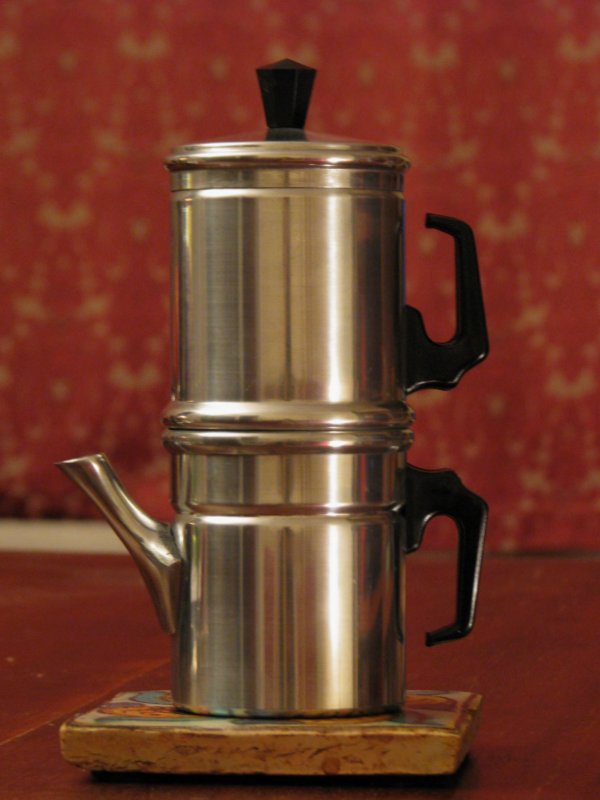
If you’ve seen a strange two-part coffee pot in an old Italian film — one of those that gets “flipped” halfway through brewing — you’ve seen a cuccumella. Americans call it the Neapolitan flip pot or napoletana; in Naples, it’s simply the coffee pot of home, the one that came before the moka. It’s the object the entire coffee tradition in the city grows out of, and in recent years it’s coming back into kitchens for its old-fashioned charm.
How it works: gravity, not pressure
Here’s where it differs completely from the moka pot, and it’s the thing that confuses people the first time they see it. The moka pushes water upward with steam pressure; the cuccumella lets water trickle down by gravity through the coffee, like a slow pour-over. No pressure means a gentler extraction: that’s why the cup is cleaner, fuller-bodied, and far less bitter than a moka’s.
The coffee that comes out is closer to a filtered drip than an espresso: intense but smooth, with a full aroma you can actually taste because there’s no “burnt” note from over-extraction.
How it’s built: the parts
The cuccumella is made of two bodies that screw together, with the filter in between. In detail:
- The water chamber — the body without a spout, the one that goes on the heat first to warm the water. It has a small vent hole on the side.
- The filter — in two parts: the basket that holds the coffee and the perforated cap that closes it.
- The collecting chamber — the body with the spout, where the finished coffee drips down.
- The little lid — mostly decorative, placed on at the end.
The ritual of the “flip”
- Fill the spoutless chamber with water, up to just below the vent hole.
- Insert the filter with the coffee and screw the spouted chamber on top.
- Put it on the heat with the spout facing down.
- When a thread of steam comes out of the vent hole, it’s time: grab the pot and flip it — the “flip” — so the boiling water passes through the coffee and drips into the part that’s now on the bottom.
Do this next to the sink: at the moment of the flip, a jet of scalding water can shoot out of the vent hole. With practice, you learn which side to hold.
For the full recipe with amounts, grind, and timing → how to brew it, step by step.
The cuppetiello
On the spout, Neapolitans often place a small paper cone, the cuppetiello, to trap the aroma while the coffee sits ready. It’s a small, very real detail of the tradition — one of those things that separates people who actually use a cuccumella from those who’ve only read about it. → The page on the cuppetiello.
Copper, aluminum, or steel?
The classic cuccumella was born in copper, then by the late 1800s moved to aluminum, cheaper and lighter. Today you’ll also find stainless steel, more durable and compatible with induction stovetops. Each has its pros and cons in heat performance and upkeep. → Aluminum, steel, or copper: how to choose.
The sizes
Like the moka, the cuccumella comes in many sizes: from a single serving up to the huge formats that, in families across the south, would come out after Sunday lunch for ten or twelve people. → The sizes (1, 3, 6, 9, 12 cups).
A bit of history (and the mystery of the name)
A surprising fact: the cuccumella wasn’t born in Naples. It was invented in Paris in 1819 by a craftsman named Morize, and it was originally made of copper. But it found its true home in Naples, so much so that it became one of the city’s symbols. The name cuccumella comes from cuccuma, meaning “copper or earthenware vessel.” Why it took the name of the city of Naples in English remains, curiously, a small mystery. → The full history of the cuccumella.
More pages on the object
How to brew it, step by step · cuccumella vs. moka · cuccumella vs. pour-over vs. French press · the sizes · aluminum, steel, or copper · how to clean and season it · the most common mistakes · the anatomy, part by part.
Ready to buy one?
The best cuccumelle · best Neapolitan coffee makers overall · Ilsa vs. Bialetti.
Frequently asked questions
Is a cuccumella the same as a moka pot? No. The moka uses pressure, the cuccumella uses gravity: a lighter, cleaner cup with less bitterness.
Why is it called a “flip pot”? Because halfway through brewing, you flip it over so the water drips down through the coffee.
Does it make coffee as strong as espresso? No — it’s closer to a full-bodied drip coffee. Intense but smooth, with little bitterness.
Where was it invented? In Paris, in 1819 — but it was in Naples that it became a tradition.